
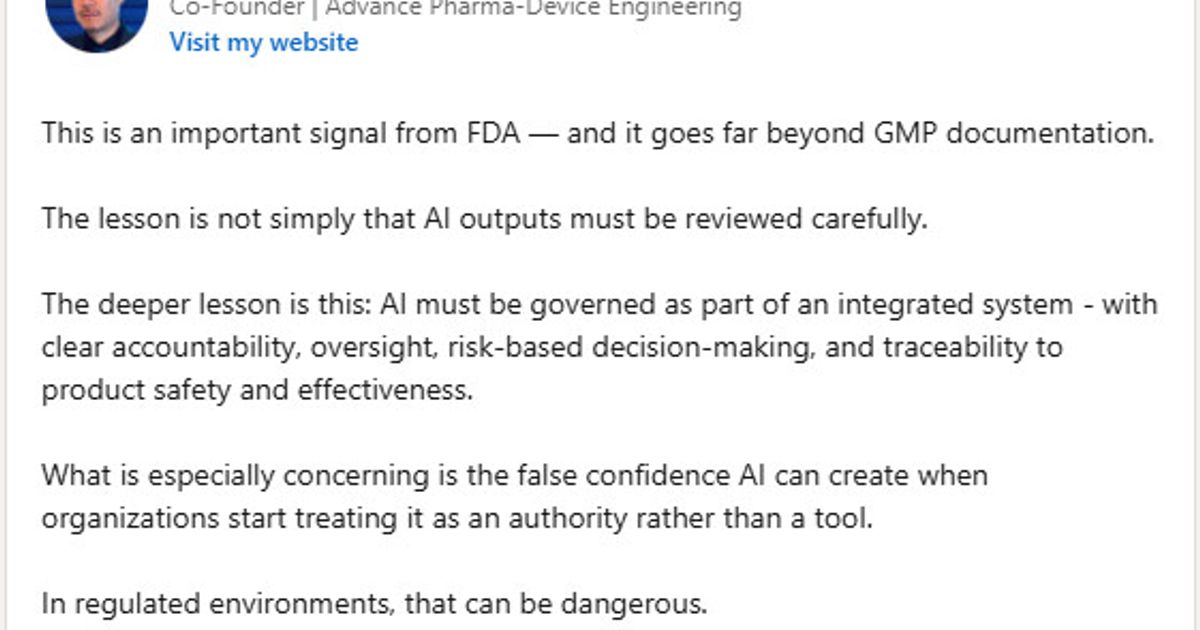
Artificial intelligence is increasingly proposed as a way to accelerate regulated medical-product development -- summarizing literature, drafting risk analyses, suggesting requirements, or flagging inconsistencies across a design history file. The conversation around adopting these tools tends to center on one question: is the model accurate? Accuracy is necessary, but it is not the question that determines whether AI can be used responsibly in a regulated environment.
Accuracy is a necessary, not sufficient, condition
A model can be highly accurate on average and still produce an output that is wrong for a specific product, a specific hazard, or a specific regulatory expectation, with no visible indication that anything is amiss. In a regulated development record, an output has to be more than statistically likely to be correct -- it has to be traceable, explainable, and defensible on its own terms, the same way a human-authored requirement, risk analysis, or verification conclusion has to be.
Define the intended use before the model
Governance starts before a model is selected. An organization should be able to state exactly what an AI-assisted tool is being used for -- drafting versus deciding, suggesting versus approving, summarizing versus concluding -- and what human review step stands between the tool's output and anything that becomes part of the product record.
What governance actually requires
- A defined, documented intended use for each AI-assisted task
- A named owner accountable for the output, not the tool
- A human review and approval step before any AI-assisted content enters the controlled record
- Evidence of what the tool was given, what it produced, and what changed after review
- A way to detect and respond to degraded or unexpected performance over time
The question is not whether the model is accurate enough. It is whether the organization can explain, after the fact, why a specific AI-assisted output was trusted and what evidence supports that trust.
Accountability cannot be automated
A tool can accelerate a task. It cannot accept accountability for the result. Every AI-assisted output that reaches a product record should have a clear human owner who reviewed it, understood its basis, and is accountable for its correctness -- the same standard already applied to any other contributor to the development record.
Where this connects to QMSpace
As AI-assisted capabilities are introduced into QMSpace, GessNet is applying this same governance standard to its own platform: defined intended use, visible review steps, and a documented trail from AI-assisted suggestion to approved product record -- so the platform models the governance it is meant to help teams achieve.